Featured Highlights

03
Contemporary
Enjoy open tuning guitar music transcribed for maximum resonance in standard tuning.


About My Arrangements, Compositions, and Recordings
Welcome to my website dedicated to sharing my enthusiasm for solo acoustic guitar. With a focus on classical, ragtime, jazz, and contemporary styles, my intent is to create and share innovative guitar pieces that resonate with both players and listeners – and that are fun and challenging to play. My recordings are made with one Sure SM81 microphone in a small studio with a lovely window overlooking a quiet graveyard. I usually record very early in the morning.
Mastering and recording a difficult guitar piece is a slow process. My arranging and composing has gotten way ahead of my playing. Most of the recordings on the website are not yet ready for prime time. However, its easy to swap in a new version so with this site I am motivating myself to keep practicing.
Guitars
I orbit between two guitars: a Cordoba C9 nylon strung classical guitar with a cedar top (luthier series) and a 1973 Martin D18 steel string acoustic
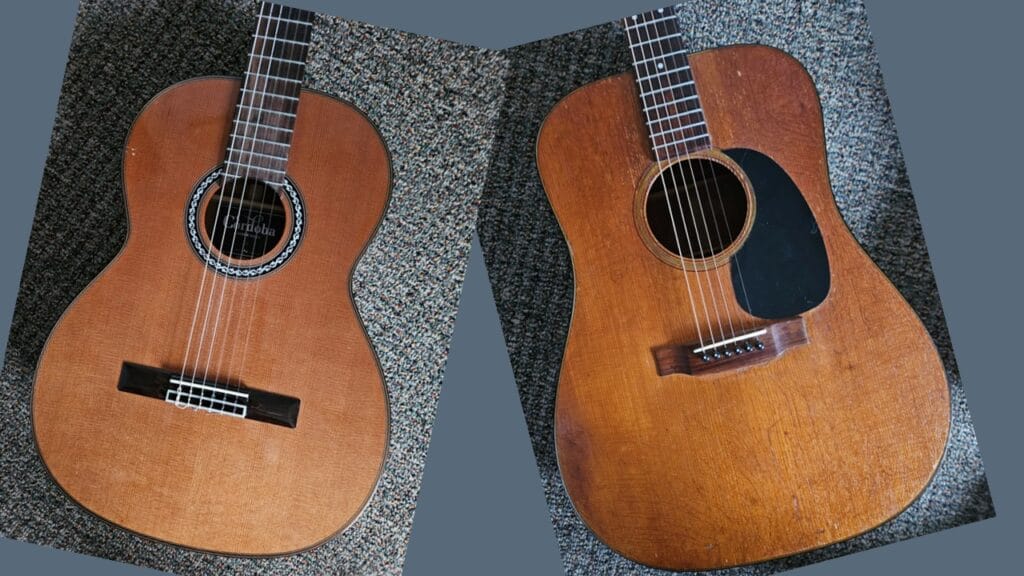
The Martin D18 was built the year Tom Waits released Closing Time, Billy Cobham released Spectrum, Bruce Cockburn released Night Visions, Herbie Handcock released Headhunters and Ton van Bergeyk released Famous Ragtime Guitar Solos. What a year! Albums were $2.99 at Budget Tapes and Records in Colorado.
Martin has been through a lot. We have explored hundreds of wild places together and once I inadvertently left it in the rain for a week in the Sangre De Cristo Mountains while I climbed Spread Eagle Peak. However, it still sounds great and plays like a dream thanks to some serious work by Kirby Francis https://francisguitarrepair.com/. I am trying to take better care of the Cordoba.
The two guitars sound very different. Compare the nylon strung Cordoba with the steel string Martin on my standard tuning arrangement of Causeway by Alex De Grassi.
Cordoba C9
Martin D18
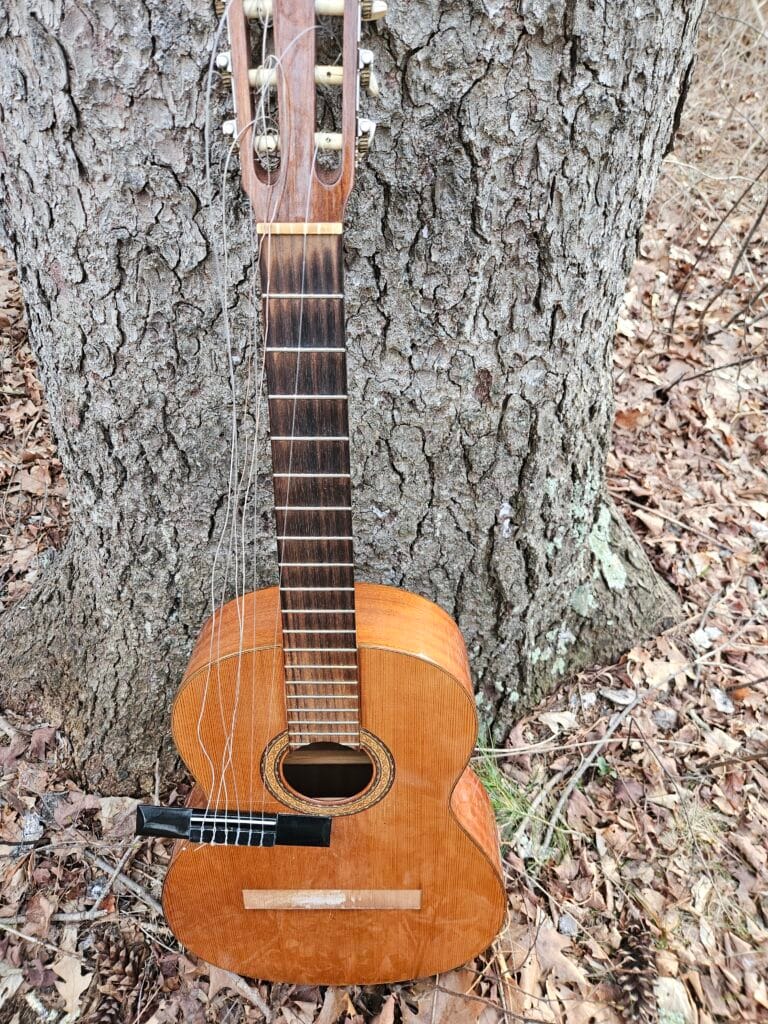
For outdoor playing I have a
Traveler Ultra-light nylon, a Martin backpacker steel and a Saez classical. As you can see here, the Saez is not always as enthusiastic about being outside as I am.
I don’t use fingernails which in guitar speak means I am a “flesh” player. I simply like the warm and more rhythmic sound of flesh on string, especially after hearing Hector Garcia play in Albuquerque New Mexico. His sound was like water flowing.
Whichever guitar I use, I strive to play with maximum resonance, ensuring that each note is heard clearly and beautifully with no distracting string and finger noise. Its an aspirational goal at the moment!
My Philosophy of Arranging
For years I explored open tunings and partial capos but now I play everything in a standard tuning (EADGBE). Life got busy and I grew impatient with changing tunings for every tune. The challenge became how to get that vibrating harp-like sound of an open tuning in a standard tuning. I discovered it can be done by using interesting chords, close voicings, open strings and unusual keys – like the enigmatic G# minor. This opened a whole new world for me where I started crafting my arrangements to increase sympathetic vibrations while retaining fluidity and phrasing around the melody or counterpoint line.
A guitar can’t match the depth of a cello or breadth of a piano (the two instruments I listen to the most) but is has two qualities I love Resonance and Rhythm. I am always trying to capture those qualities which, to my ears, are sublimely expressive and accentuate the beauty of acoustic guitar.
Why I Love Arranging Music
Whenever I hear a beautiful piece of music I wonder, how would I evoke that sound on guitar. The limits of the instrument brings out creativity. Puzzling out the arrangement, combined with the physical joy of playing it and the satisfaction of hearing new sounds emerge, is completely addicting.
Arranging is also a great way to dive deep into someone else composition. Sometimes when working out a Bach piece I suddenly see and understand how he wove melodic lines together to suggest a larger structure. It can be so moving I have to stand up and walk around.
It is similar with open-tuning pieces. In the originals pieces, the string tensions are tightened or loosened changing the actual pitch of the string and shifting all the relationships between strings. I learned to play these pieces in their open tunings but I didn’t understand them. Arranging them into standard tuning I can fully appreciate what the composer had done, which allows me to improvise and recombine ideas.
Other guitarists claim that playing guitar acts as a stress reliever fostering creativity and offering a deep sense of accomplishment. Because it combines cognitive stimulation with emotional expression and physical coordination, it gives players a dopamine hit when mastering a new song. I don’t know if this is true but it certainly sounds plausible. Download some tablature and give it a try yourself!